


Best Asset Tracking Software of 2026
Updated January 27, 2025 at 9:55 AM
- Popular Comparisons
- FrontRunners
- Buyers Guide
- Related Software
Compare Products
Showing 1 - 25 of 341 products
Compare Products
Sort by
Reviews: Sorts listings by the number of user reviews we have published, greatest to least.
Average Rating: Sorts listings by overall star rating based on user reviews, highest to lowest.
Alphabetically (A-Z): Sorts listings by product name from A to Z.

MaintainX is a maintenance and asset management platform built for industrial and frontline teams. It helps organizations stream...Read more about MaintainX


MaintainX's Best Rated Features
See All
MaintainX's Worst Rated Features
See All

Coast is a leading maintenance management software, designed to help the deskless workforce succeed. Our all-in-one, adaptable s...Read more about Coast
Coast's Best Rated Features
See All
Coast's Worst Rated Features
See All

Fiix is a cloud-based computerized maintenance management system (CMMS) that helps businesses organize their maintenance departm...Read more about Fiix


Fiix's Best Rated Features
See All
Fiix's Worst Rated Features
See All

Maint CMMS is a cloud-based solution that enables maintenance professionals to monitor, capture, store and share historical asse...Read more about eMaint CMMS
eMaint CMMS's Best Rated Features
See All
eMaint CMMS's Worst Rated Features
See All

Asset Essentials is a cloud-based maintenance solution that generates operational insights from asset and work order management ...Read more about Asset Essentials

Asset Essentials's Best Rated Features
See All
Asset Essentials's Worst Rated Features
See All

Manage your fixed assets from acquisition to disposal with our best-in-class, comprehensive solution, Sage Fixed Assets. Capture...Read more about Sage Fixed Assets
Sage Fixed Assets's Best Rated Features
See All
Sage Fixed Assets's Worst Rated Features
See All

Limble is a CMMS platform designed to optimize maintenance operations and improve compliance. Its work order management allows u...Read more about Limble

Limble's Best Rated Features
See All
Limble's Worst Rated Features
See All

eWorkOrders CMMS is a cloud-based computerized maintenance management system designed to streamline maintenance operations and e...Read more about eWorkOrders CMMS
eWorkOrders CMMS's Best Rated Features
See All
eWorkOrders CMMS's Worst Rated Features
See All

Maintenance Connection is a multi-site, multi-industry CMMS and EAM tool that streamlines maintenance operations across industri...Read more about Maintenance Connection
Maintenance Connection's Best Rated Features
See All
Maintenance Connection's Worst Rated Features
See All

FMX is a web-based facilities and maintenance management solution designed for K-12 schools, higher education institutions, muni...Read more about FMX
FMX's Best Rated Features
See All
FMX's Worst Rated Features
See All

PrecisionERP is an all-in-one business software solution seamlessly integrates Enterprise Resource Planning (ERP), Customer Rela...Read more about PrecisionERP
No reviews yet
recommendations


Looking for an easier way to keep track of your equipment, software, and inventory? Hector is a cloud-based asset inventory mana...Read more about Hector


TheWorxHub, designed by Brightly Software specifically for healthcare, is the most user-friendly, cloud-based CMMS solution toda...Read more about TheWorxHub
TheWorxHub's Best Rated Features
See All
TheWorxHub's Worst Rated Features
See All

EZO is a cloud-based asset management software designed to help organizations track, manage, and maintain physical assets from a...Read more about EZO


EZO's Best Rated Features
See All
EZO's Worst Rated Features
See All

MAPCON is a maintenance management solution for manufacturing and facilities industries that offers standalone asset management,...Read more about MAPCON

Proactively manage your assets, simplify work orders, plan capital improvement projects, and make the most of your resources wit...Read more about OpenGov Enterprise Asset Management


ServiceChannel is the #1 facilities management system, helping you deliver an outstanding customer experience at every location....Read more about ServiceChannel


ServiceChannel's Best Rated Features
See All
ServiceChannel's Worst Rated Features
See All

Timly is a cloud-based inventory management solution designed for small and large businesses. The tool digitizes inventory proce...Read more about Timly

Timly's Best Rated Features
See All
Timly's Worst Rated Features
See All

UpKeep is a web-based CMMS offering a mobile-first solution for maintenance teams, streamlining operations with asset and workfl...Read more about UpKeep
UpKeep's Best Rated Features
See All
UpKeep's Worst Rated Features
See All

Facilio provides a Connected CMMS platform that helps you to unify all your property operations and maintenance to get real-time...Read more about Facilio

Facilio's Best Rated Features
See All
Facilio's Worst Rated Features
See All

Sortly is an inventory management software designed to help businesses track and organize physical inventory, supplies, material...Read more about Sortly
Sortly's Best Rated Features
See All
Sortly's Worst Rated Features
See All

In the dynamic world of municipal management, efficiency, transparency, and accountability are paramount. CityReporter is your t...Read more about CityReporter

CityReporter's Best Rated Features
See All
CityReporter's Worst Rated Features
See All

MobiWork© is the leading field services management software solution and is the perfect fit for any small, mid-size, or large fi...Read more about MobiWork

MobiWork's Best Rated Features
See All
MobiWork's Worst Rated Features
See All

Fracttal One is a smart maintenance platform designed to help organizations manage their maintenance operations using AI-powered...Read more about Fracttal One

Fracttal One's Best Rated Features
See All
Fracttal One's Worst Rated Features
See All

Infraspeak is a collaborative platform that enables end-to-end collaboration, visibility and efficiency to facilities management...Read more about Infraspeak
Infraspeak's Best Rated Features
See All
Infraspeak's Worst Rated Features
See All
Popular Comparisons



Your Guide to Top Asset Tracking Software, September 2025
Software Advice uses reviews from real software users to highlight the top-rated Asset Tracking products in North America.
Learn how products are chosenExplore FrontRunners


“Usability” includes user ratings for Functionality and Ease of Use.
“Customer Satisfaction” includes user ratings for Customer Support, Likelihood to Recommend and Value for Money.
Reviews analysis period: The reviews analysis period spans two years and ends the 15th of the month prior to publication.

Buyers Guide
This detailed guide will help you find and buy the right asset tracking software for you and your business.
Last Updated on January 27, 2025Asset tracking software helps users manage the location of, and work performed on, each piece of equipment or machinery throughout an organization. These systems share many capabilities with maintenance software and facilities management systems. However, asset tracking software often includes barcoding or radio-frequency identification (RFID) tags to quickly retrieve data about the machine.
This guide will outline the common capabilities of an asset tracking system, as well as factors buyers should consider when purchasing one. We’ll cover:
What Is Asset Tracking Software?
Common Functionality of Asset Tracking Systems
What Is Asset Tracking Software?
Keeping tabs on machinery, tools and other assets is critical in ensuring a company’s operations are uninterrupted. After all, asset failure and machine downtime can wreak havoc on a business’s bottom line.
An asset tracking system offers ways for users to digitally track the location of assets that have been physically tagged. It also stores asset information and inventory data, and can alert managers when spare parts stock is low.
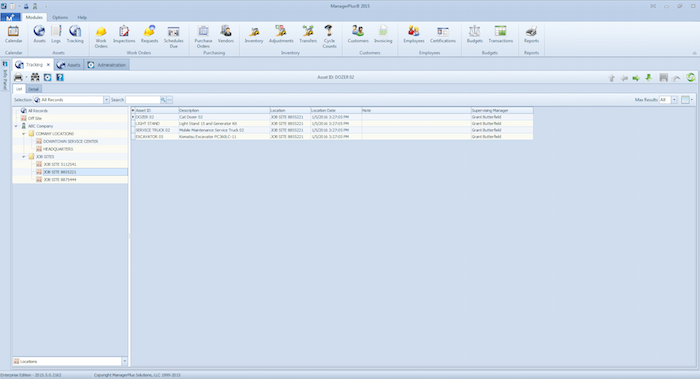
Equipment data, including ID number, description and location, in ManagerPlus
Using software to track these assets can help:
Ensure scheduled maintenance is completed on time
Set up alerts and notifications so that the appropriate personnel are automatically assigned to tasks when new work orders are created
Track the life cycle of assets. Information about equipment condition, age and more is entered and stored in the system
Run reports and calculate depreciation of machinery
Common Functionality of Asset Tracking Systems
Most asset tracking systems include some or all of the following capabilities:
Work order management | The primary reason maintenance professionals need to track assets throughout an organization is to ensure assets are at peak condition and performing the task to which they’re assigned. Therefore, many asset tracking systems also include some kind of work order management functionality, allowing users to create and review work orders and assign them to technicians. |
Barcoding or RFID tagging | A useful functionality found in asset tracking software is barcoding, QR coding or RFID tagging. Users can create a barcode or QR code system by printing labels and attaching them to machinery. When technicians arrive at the asset to perform work, they can scan the barcode with a hand-held reader or capable smartphone to retrieve important information about that machine. This can save time traveling between the job site and the office computer, while increasing the accuracy of data workers use to perform their duties. |
Depreciation | Asset tracking software can also assist companies with calculating depreciation for each piece of equipment. Users simply enter information about an asset, such as date of purchase, acquisition value and estimated service life, then choose from several depreciation methods (straight-line, MACRS, double-declining balance etc.) to have values calculated automatically. |
Equipment rental | Some companies have assets that can be checked out by employees outside the maintenance department. These rentals should be documented so that equipment can be restored if lost or damaged; Or, if there is a repair to be performed, a technician can see where it is and who is in possession of the asset. Asset tracking software allows users to check equipment in and out: they can assign an employee to a piece of equipment, log the check-out and check-in dates and even store a signature for the renter. |
Mobile applications | The ability to use smartphones and tablets in the field increases efficiency for maintenance departments, giving technicians access to asset data wherever they’re located. Mobile capabilities are a major part of asset tracking. Users can download native applications for mobile devices and scan barcodes or QR codes to instantly view information about a piece of equipment. If the system offers inventory management capabilities, barcoding can also be used to update inventory quantities in real time: Simply scan a code and change the values for certain spare parts as they are consumed. |
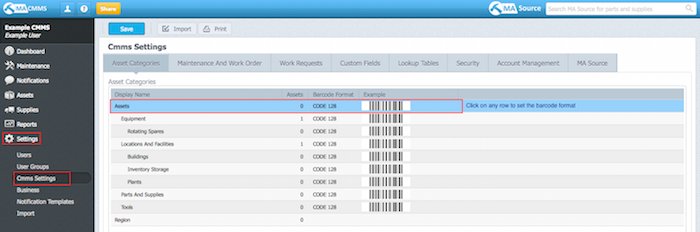
Setting up barcode formats in Maintenance Assistant
What Type of Buyer Are You?
Some specific asset tracking capabilities, such as barcoding, can be particularly useful for certain industries. Here are a few types of buyers that can benefit the most from these systems:
Managers from manufacturing, healthcare or other asset-intensive industries. Companies with many pieces of equipment and machinery need a reliable way to manage scheduled maintenance. Manufacturers must keep critical machines operational in order to produce goods. And hospital maintenance managers have to ensure equipment stays running for the safety of employees and patients.
Using a barcoding system to retrieve condition information and work-order status saves time that could otherwise be spent maintaining the most critical machinery.
Facilities managers. Professionals who manage building maintenance also need to track equipment inside the facilities, such as HVAC units and lighting, to ensure occupants are able to work. Asset tracking software can alert workers when assets require repairs so they can address the problems quickly.
Fleet maintenance managers. Rolling assets can be especially challenging to track and maintain. Businesses that rely on a fleet of vehicles need to know exactly where any given truck, bus or van is located so that maintenance can be scheduled accordingly. Using an asset tracking system, managers can organize maintenance based on the vehicle’s location. This allows them to maximize the time vehicles are on the road in the most cost-efficient way.