Best Business Phone Systems software of 2026

- FrontRunners
- Popular Comparisons
- Buyers Guide
Compare Products
Showing 1 - 25 of 145 products
Compare Products
Sort by
Reviews: Sorts listings by the number of user reviews we have published, greatest to least.
Average Rating: Sorts listings by overall star rating based on user reviews, highest to lowest.
Alphabetically (A-Z): Sorts listings by product name from A to Z.

RingEX is a cloud-based business communications solution that offers tools for Messaging, Video and Phone. Core features of the ...Read more about RingEX


RingEX's Best Rated Features
See All
RingEX's Worst Rated Features
See All

Dialpad is an AI-enabled customer communications platform that includes a phone system, video conferencing, cloud contact center...Read more about Dialpad


Dialpad's Best Rated Features
See All
Dialpad's Worst Rated Features
See All

ULTATEL enables people to work together and get the information they need to do their best work, anywhere they are. Our cloud p...Read more about Ultatel Cloud Business Phone System


Ultatel Cloud Business Phone System's Best Rated Features
See All
Ultatel Cloud Business Phone System's Worst Rated Features
See All

Twilio is a cloud communications platform that enables businesses to build, scale and operate their own customized communication...Read more about Twilio

Twilio's Best Rated Features
See All
Twilio's Worst Rated Features
See All

Cloud Hosted Phone, VoIP & UCaaS- metricVOICE by Fastmetrics. Smarter communications from $15 per month. Connect how you work, ...Read more about metricVOICE


DialedIn is a cloud-based Contact Center as a Service (CCaaS) solution designed to optimize outbound, inbound, and blended call ...Read more about DialedIn CCaaS
DialedIn CCaaS's Best Rated Features
See All
DialedIn CCaaS's Worst Rated Features
See All

Ringover is the no.1 business phone system that gives you unlimited calls to 110 countries, video conferencing, SMS and group me...Read more about Ringover
Ringover's Best Rated Features
See All
Ringover's Worst Rated Features
See All

VoIP.ms is a cloud-based internet phone service solution designed to help businesses manage local, mobile and toll-free number p...Read more about VoIP.ms
VoIP.ms's Best Rated Features
See All
VoIP.ms's Worst Rated Features
See All

Telnyx Suite is a comprehensive cloud communication platform that provides communication capabilities via voice, SMS, fax, and I...Read more about Telnyx Suite


Telnyx Suite's Best Rated Features
See All
Telnyx Suite's Worst Rated Features
See All

Global Call Forwarding is a provider of toll-free, international, and local phone numbers. Buy virtual phone numbers from more ...Read more about Global Call Forwarding
Global Call Forwarding's Best Rated Features
See All
Global Call Forwarding's Worst Rated Features
See All

OnSIP Hosted OnSIP Hosted VoIP by Junction Networks is a cloud-based phone solution that offers businesses across various indust...Read more about OnSIP

OnSIP's Best Rated Features
See All
OnSIP's Worst Rated Features
See All

AVOXI is a global communications provider specializing in cloud-based contact center and virtual number solutions. Their platfor...Read more about AVOXI
AVOXI's Best Rated Features
See All
AVOXI's Worst Rated Features
See All

Nextiva is a customer experience management platform that consolidates all customer interactions into one AI-powered solution. T...Read more about Nextiva
Nextiva's Best Rated Features
See All
Nextiva's Worst Rated Features
See All

CommPeak’s VoIP service supports global businesses and contact centers that manage high call volumes and need consistent call qu...Read more about CommPeak VoIP Service
CommPeak VoIP Service's Best Rated Features
See All
CommPeak VoIP Service's Worst Rated Features
See All

Kixie: AI-Powered Revenue Communication for High-Performing Teams Kixie is a next-generation revenue engagement platform that h...Read more about Kixie PowerCall
Kixie PowerCall's Best Rated Features
See All
Kixie PowerCall's Worst Rated Features
See All

Spoke is the leading platform for high-value, complex, and regulated conversations. Spoke guides employees to say and collect th...Read more about Spoke Phone
Spoke Phone's Best Rated Features
See All
Spoke Phone's Worst Rated Features
See All

VoIPstudio is a cloud-based call center management solution designed for businesses of all sizes. It offers features that includ...Read more about VoIPstudio
VoIPstudio's Best Rated Features
See All
VoIPstudio's Worst Rated Features
See All

VirtualPBX is a cloud-based phone solution that caters to all-sized businesses. VirtualPBX enables companies to streamline and i...Read more about VirtualPBX

VirtualPBX's Best Rated Features
See All
VirtualPBX's Worst Rated Features
See All

Unitel Voice is the business builder's phone system. It lets you run your business from anywhere using any device. Easy to set u...Read more about Unitel Voice
Unitel Voice's Best Rated Features
See All
Unitel Voice's Worst Rated Features
See All

TalkChief isn't just a business phone system; it's your partner in enhancing communication for call centers, startups, enterpris...Read more about TalkChief
TalkChief's Best Rated Features
See All
TalkChief's Worst Rated Features
See All

Monster VoIP is a Unified Communications as a Service (UCaaS) solution that helps voice-over-internet-protocol (VoIP) providers ...Read more about Monster VoIP

RingByName is a cloud-based phone and VOIP service provider that offers e-fax, teleconferencing tools, note sharing, customer re...Read more about RingByName

RingByName's Best Rated Features
See All
RingByName's Worst Rated Features
See All

Cloud Voice for Microsoft Teams from UniVoIP Why Use Microsoft Teams as a Phone System? ● You already have M365, so maximize ...Read more about UniVoIP

Yeastar P-Series Cloud PBX is a business communication solution that offers companies of all sizes with a complete package for c...Read more about Yeastar Cloud PBX

Zoom Phone is a VoIP solution designed to help businesses in education, finance, healthcare and government sectors connect and c...Read more about Zoom Phone
Zoom Phone's Best Rated Features
See All
Zoom Phone's Worst Rated Features
See All
Popular Comparisons



Your Guide to Top Business Phone Systems Software, October 2024
Software Advice uses reviews from real software users to highlight the top-rated Business Phone Systems products in North America.
Learn how products are chosenExplore FrontRunners


“Usability” includes user ratings for Functionality and Ease of Use.
“Customer Satisfaction” includes user ratings for Customer Support, Likelihood to Recommend and Value for Money.
Reviews analysis period: The reviews analysis period spans two years and ends the 15th of the month prior to publication.
Buyers Guide
This detailed guide will help you find and buy the right business phone service providers software for you and your business.
Last Updated on January 27, 2025Who are business phone service providers?
Business phone service providers help businesses manage phone calls. They offer the service via Voice over Internet Protocol (VoIP), Plain Old Telephone Service (POTS), cellular network, and Primary Rate Interface (PRI), based on a client’s preference. The service includes routing inbound calls, managing voicemail, forwarding calls, managing caller ID, and recording calls.
Clients can use this service to make phone calls within and outside the organization for purposes such as providing customer support, managing sales calls, and communicating with vendors.
Business phone service has transformed dramatically over recent decades—so it’s critical to know your options if you’re thinking about switching providers or replacing your phone system.
Recent changes in carriers’ offerings have mainly been driven by the evolution of Voice over Internet Protocol (VoIP) technology. VoIP makes it possible to send phone calls over the Internet, as opposed to traditional phone lines.
VoIP service is technically complex, so you’ll need to understand the key elements of a solution before you begin evaluating providers. Additionally, there are reasons to explore other types of phone service besides VoIP even though most businesses are now migrating to VoIP service when they need a new system.
We’ve written this buyer’s guide to familiarize you with the major kinds of business phone service on the market today. Here are the topics we’ll explore:
Phone Service Types: POTS, VoIP, Cellular and PRI
Pros and Cons of Different Service Types
Finding the Right Service Type for Your Phone System
The Difference between SIP Trunking Service and Business VoIP Phone Service
Phone Service Types: POTS, VoIP, Cellular and PRI
The following graphic breaks down the basic types of voice service available in North America:
Voice Service Types
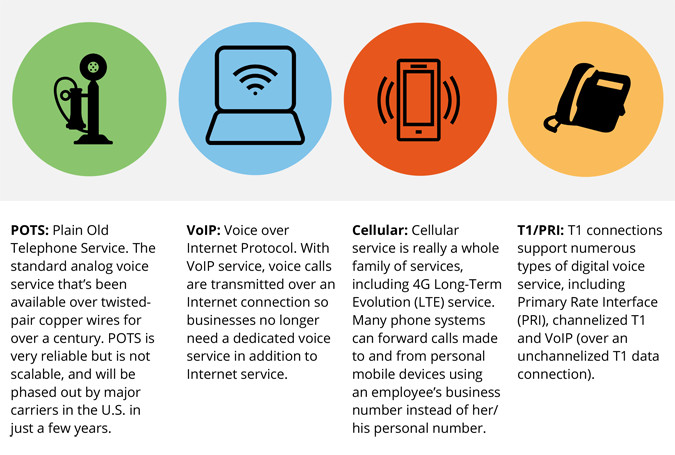
POTS offers one unique advantage over other kinds of voice service: POTS transmits voice information as an analog audio signal using electricity, so POTS lines supply power to both phones and voice service. This means that POTS will keep phones ringing even if the power gets knocked out.
That said, the FCC is currently overseeing the sunset of the traditional copper telephone network. If you’re currently using POTS, you need to be aware that copper phone lines will be dead for good in just a few more years.
VoIP is a technology that transmits real-time voice information as data using an Internet connection.
VoIP differs from other digital voice services in that the voice information isn’t just digitized, but also transmitted using Internet Protocol (IP). This means you can use broadband Internet access for both voice and data. Other kinds of digital voice service businesses need both Internet and voice service.
VoIP can be used with various types of Internet access, including:
Broadband cable
DSL
Fiber optic
T1
You just need sufficient bandwidth for the calls. Just like streaming video, VoIP demands lots of bandwidth, as calls are streamed in real-time.
Cellular service only supported voice calling at one point, but it now refers to a family of services that also enable wireless data connections to the Internet.
On a smartphone, a voice call can be routed via the cellular carrier, which will rack up per-minute rates. However, the call can also be sent over a long-term evolution (LTE) data connection, so you only pay for the data used by the call—no per-minute rates.
This is a variation on VoIP known as Voice over LTE, or VoLTE. (While LTE refers specifically to 4G networks, a 3G or wireless Internet connection can also be used.)
Finally, T1 connections support a whole family of digital voice services:
Primary Rate Interface (PRI) service is a specialized type of digital voice service that’s been available since the 1980s. With PRI, a T1 trunk line is divided into 24 channels, 23 of which can be used for voice calls. The 24th channel is utilized for signalling information like caller ID. While PRI has been in use in enterprise contact centers for decades, the technology has limitations when it comes to scalability. In particular, because only 23 channels are available for voice calls, a business will need to buy a whole new trunk line with another 23 channels for calls in order to handle 24 calls at once. This means that you’re essentially paying for unused capacity. VoIP, on the other hand, is much more scalable and affordable in North America. (There are regional cases to be made for using PRI in other countries.)
Channelized T1 is a T1 trunk divided into 24 channels for voice calls. With channelized T1, there’s no separate channel for signalling information as there is with PRI, which means the service can’t support essential capabilities, such as caller ID.
Unchannelized T1 is just that: a trunk line that hasn’t been divided into channels. Unchannelized T1 is used for data service, whereas PRI and channelized T1 are used for voice service. An unchannelized T1 connection can support VoIP service.
Pros and Cons of Different Service Types
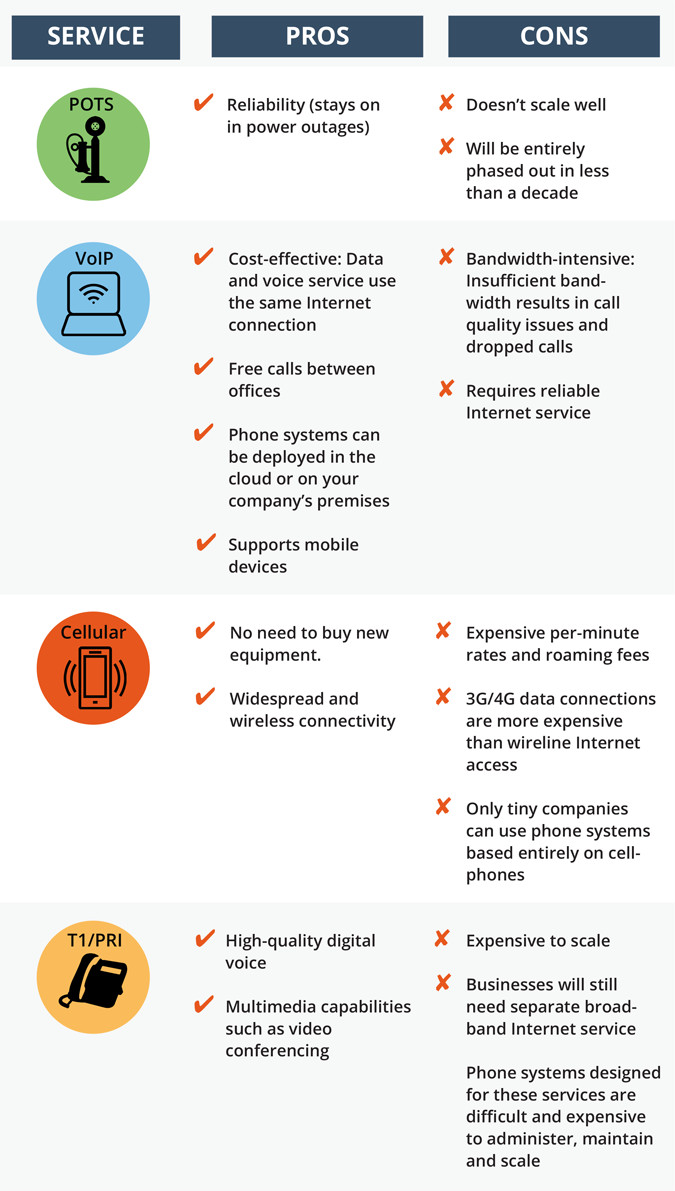
The table below summarizes the advantages and disadvantages of each service type:
Finding the Right Service Type and Provider for Your Phone System
There are two basic elements of a communications solution: the hardware- or software-based phone system (also known as a Private Branch eXchange or PBX system), and the phone service that allows you to make and receive calls.
Contemporary phone systems can be based on hardware or software deployed at your company, on-premise, or they can be hosted in the cloud.
Some businesses don’t even have desk phones—just softphone applications installed on laptops that connect via the Internet to a phone system in the service provider’s data center.
VoIP-based systems are particularly flexible in this respect.
The table below shows the major phone system types and the voice services they work with. Definitions of each system can be found below the table:
System Type | POTS | PRI | VoIP | Cellular |
Traditional PBX | ✓ | ✓ |
|
|
Cloud-based or on-premise IP PBX |
|
| ✓ | ✓ |
Hybrid PBX | ✓ | ✓ | ✓ | ✓ |
Virtual PBX |
|
|
| ✓ |
A traditional PBX is a system designed either for analog voice service or PRI service (in addition to other types of digital voice service based on time-division multiplexing, which is the fundamental technology behind PRI service).
An Internet Protocol PBX or IP PBX is a system designed specifically for VoIP service. An IP PBX can be deployed on your business’s premises or in the cloud.
A hybrid PBX is a system that can handle both VoIP service and traditional analog and digital voice services.
A virtual PBX is a stripped-down hosted phone system designed for very small businesses that primarily want to use employees’ personal cell phones for business communications. No hardware or software is deployed at the business’s premises. Instead, employees get special work phone numbers. When a call is made to one of these work numbers, the virtual PBX provider forwards it to the employee’s personal mobile device.
Similarly, employees can call out from their mobile devices using their work numbers, though some virtual PBX solutions have limits when it comes to outbound dialing; others treat it as an add-on capability. Virtual PBX solutions also offer a very limited set of basic phone system features like auto attendants.
The Difference Between SIP Trunking Service and Business VoIP Phone Service
As we’ve explained, calls between offices are free with business VoIP service because they don’t have to travel over the traditional phone network (known as the Public Switched Telephone Network or PSTN). This is also why services such as Skype offer free voice and video calls, but only to other Skype users.
In order to connect calls between VoIP numbers and numbers serviced by the PSTN in this country or internationally, you need a special service known as SIP trunking. SIP trunking is a complex network service, but it essentially acts as a bridge across which voice calls can travel between the Internet and the PSTN.
Confusingly, the term “VoIP service” can refer either to the delivery of phone system functions (call routing, voicemail, call recording etc.) over the Internet with a cloud-based PBX, or to SIP trunking service.
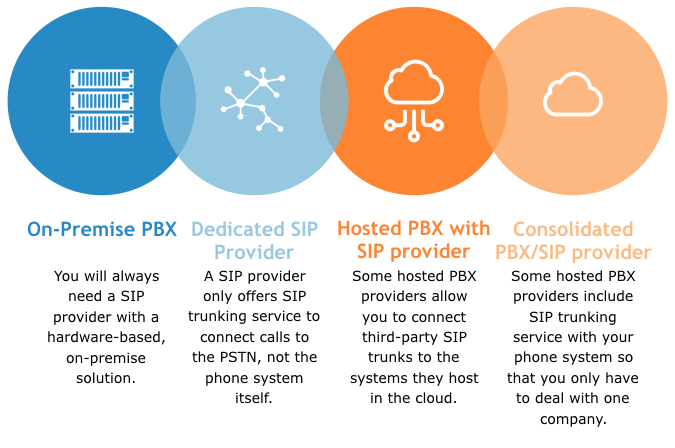
With an on-premise IP PBX, you’ll need a SIP trunking provider to connect calls, unless you’re planning to restrict communications to calls between offices.
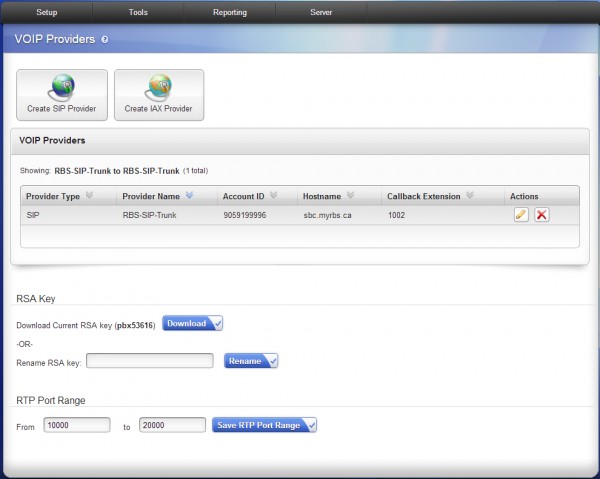
Configuring SIP providers in Digium Switchvox
With a cloud-based PBX, you may or may not need a separate SIP provider.
Many cloud PBX vendors handle SIP trunking for their customers via their relationships with major carriers. This means that you only need to deal with one company for both your phone system and SIP trunking needs.
On the other hand, some businesses choose to go with separate companies: one for the phone system and one for SIP trunking. This setup makes sense if your SIP provider is offering you particularly good rates on calls, or if you’ve had good experiences with the providers’ uptime and quality of support.
You can connect SIP trunks from various providers to a phone system hosted in the cloud, just as you can with a phone system on your business’s premises.
Whether you have a cloud-based or on-premise IP PBX, you’ll need to make sure that your SIP trunking provider is compatible with your phone system (unless, of course, the same company is handling your hosted system and your SIP trunking).
The graphic below shows the different ways in which SIP trunking can be combined with VoIP systems:
Different SIP Trunking Setups with IP PBX Systems