


Best CRM for Startups software of 2026

- FrontRunners
- Popular Comparisons
- Buyers Guide
Compare Products
Showing 1 - 25 of 514 products
Compare Products
Sort by
Reviews: Sorts listings by the number of user reviews we have published, greatest to least.
Average Rating: Sorts listings by overall star rating based on user reviews, highest to lowest.
Alphabetically (A-Z): Sorts listings by product name from A to Z.

Thryv is an AI-powered marketing and sales platform built specifically for small businesses, helping you market smarter, sell mo...Read more about Thryv


Thryv's Best Rated Features
See All
Thryv's Worst Rated Features
See All

Claritysoft is a cloud-based customer relationship management (CRM) solution designed for midsize and large enterprise businesse...Read more about Claritysoft CRM


Claritysoft CRM's Best Rated Features
See All
Claritysoft CRM's Worst Rated Features
See All

LeadMaster is a SaaS-based all-in-one lead management solution that offers capabilities to capture, track and follow up with lea...Read more about LeadMaster

BNTouch Mortgage CRM is a fully integrated digital mortgage system, CRM, marketing, and POS tool offering a comprehensive mortga...Read more about BNTouch Mortgage CRM


BNTouch Mortgage CRM's Best Rated Features
See All
BNTouch Mortgage CRM's Worst Rated Features
See All

Sales Cloud is equipped with customer relationship management (CRM) functionality that encompasses lead management, marketing au...Read more about Salesforce Sales Cloud


Salesforce Sales Cloud's Best Rated Features
See All
Salesforce Sales Cloud's Worst Rated Features
See All

Supercharge your sales process with Sales Hub, a powerful and easy-to-use sales CRM that includes sales engagement tools, config...Read more about HubSpot Sales Hub

HubSpot Sales Hub's Best Rated Features
See All
HubSpot Sales Hub's Worst Rated Features
See All

Shape's cloud-based solution offers tools designed to manage online marketing and promotions, capture leads from online sources,...Read more about Shape

Shape's Best Rated Features
See All
Shape's Worst Rated Features
See All

Clio provides a cloud-based solution designed to streamline various aspects of law firm operations. Its platform supports essent...Read more about Clio
Clio's Best Rated Features
See All
Clio's Worst Rated Features
See All

Pipeliner has revolutionized CRM with our unique visual interface, no-code workflow automation engine, and instant, dynamic insi...Read more about Pipeliner CRM

Pipeliner CRM's Best Rated Features
See All
Pipeliner CRM's Worst Rated Features
See All

SalesNOW by Interchange Solutions Inc. is a cloud-based customer relationship management (CRM) and sales force automation soluti...Read more about SalesNOW
SalesNOW's Best Rated Features
See All
SalesNOW's Worst Rated Features
See All

Document360 is an AI-powered knowledge base platform built for enterprises that need secure, scalable documentation. It centrali...Read more about Document360

Document360's Best Rated Features
See All
Document360's Worst Rated Features
See All

LeadSquared is a cloud-based marketing automation and customer relationship management (CRM) solution for businesses of all size...Read more about LeadSquared


LeadSquared's Best Rated Features
See All
LeadSquared's Worst Rated Features
See All

CallProof is built for leaders who manage outside and field sales teams and want a simple way to know what’s really happening in...Read more about CallProof

Zoho CRM is a cloud-based business management platform that caters to businesses of all sizes. It offers sales and marketing aut...Read more about Zoho CRM
Zoho CRM's Best Rated Features
See All
Zoho CRM's Worst Rated Features
See All

MortgageHalo from Halo Programs is a cloud-based customer relationship management (CRM) solution designed for the residential mo...Read more about MortgageHalo


Rock Solid OneView is a Microsoft Dynamics-based citizen engagement platform that helps citizens and local governments work as o...Read more about Rock Solid
No reviews yet
recommendations


An Inc. 5000 fastest growing private company, recognized by Gartner as a top viable vendor for Integrated Revenue and Customer M...Read more about Symphony

Zendesk is a cloud-based help desk management solution offering customizable tools to build customer service portal, knowledge b...Read more about Zendesk Suite

Zendesk Suite's Best Rated Features
See All
Zendesk Suite's Worst Rated Features
See All

SAP Customer Experience is a cloud-based customer relationship management solution that helps small and mid-size businesses mana...Read more about SAP Customer Experience
SAP Customer Experience's Best Rated Features
See All
SAP Customer Experience's Worst Rated Features
See All

SalesOutlook CRM is a comprehensive customer relationship management (CRM) and email marketing system that embeds into Microsoft...Read more about SalesOutlook CRM

SalesOutlook CRM's Best Rated Features
See All
SalesOutlook CRM's Worst Rated Features
See All

CharityEngine's nonprofit CRM software simplifies the fundraising process, so you spend more time on your campaigns and less tim...Read more about CharityEngine
CharityEngine's Best Rated Features
See All
CharityEngine's Worst Rated Features
See All

RealEstateHalo from Halo Programs is a cloud-based solution for the residential real estate industry. The platform offers built...Read more about RealEstateHalo


Lofty is an award-winning, all-in-one marketing, lead generation, and customer relationship management (CRM) platform built spec...Read more about Lofty
Lofty's Best Rated Features
See All
Lofty's Worst Rated Features
See All

HelpCrunch is a customer communication platform combining live chat, email marketing automation and a help desk in one solution....Read more about HelpCrunch
HelpCrunch's Best Rated Features
See All
HelpCrunch's Worst Rated Features
See All

Universal Knowledge is a knowledge management solution designed by Knowledge Powered Solutions to increase the efficiency of age...Read more about Universal Knowledge
Popular Comparisons



Your Guide to Top CRM for Startups Software, October 2022
Software Advice uses reviews from real software users to highlight the top-rated CRM for Startups products in North America.
Learn how products are chosenExplore FrontRunners


“Usability” includes user ratings for Functionality and Ease of Use.
“Customer Satisfaction” includes user ratings for Customer Support, Likelihood to Recommend and Value for Money.
Reviews analysis period: The reviews analysis period spans two years and ends the 15th of the month prior to publication.

Buyers Guide
This detailed guide will help you find and buy the right crm for startups software for you and your business.
Last Updated on January 27, 2025Startups—they're not just the youngest members of the business world. Their new ideas and limitless potential draw a lot of attention. And while it's easy to poke fun at their button-down cultures, the truth is: startups regularly face some of the business world's toughest and most high-stakes decisions. Fortune 500 companies rarely encounter make-or-break decisions. For a startup, every decision can be make or break.
The selection of a CRM system is one of the most important decisions a startup can make. It's also one of the most challenging. This Buyer's Guide helps startups meet these challenges by answering and explaining the following:
A Comparison of Top CRM for Startups Solutions
Common Features of CRM for Startups
Deployment and Purchasing Options for CRM for Startups
What Is CRM for Startups?
CRM software comes in more shapes and sizes than probably any other genre of enterprise software. Aside from all-purpose CRM, there's CRM for small businesses, CRM specifically for retail establishments, for banks, insurance agencies and even casinos. That's a lot to consider!
But what about startups? That's where things get complicated. It's easy to see how banks, insurance agencies and casinos would have different requirements for CRM. After all, their Cs (customers) are different, and their Rs (relationship with their customers) are different, so it's no surprise that they'd be managed differently as well.
A handful of vendors representing the tip of the CRM iceberg
But "startup" is a stage of growth, not an industry vertical. So unlike with banking and insurance, there's no way to generalize about the typical startup customer or a startup's typical relationship with a customer. Those things don't exist.
Instead, CRM for startups is software that caters to the particular needs of companies in the early stages of growth. Those particular needs can be generalized, so let's do that! Startups generally do best with CRM software that:
Prioritizes usability with intuitive UIs and workflows, allowing staff to get up to speed with minimal training or interruption
Is highly scalable, working equally well with a dozen or a thousand customers
Is flexible enough (through customizations, modules or add-ons) to pivot when the startup pivots and support changes in company strategy and policy (rather than hinder them)
With those priorities in mind, let's look now at some specific functionality.
A Comparison of Top CRM for Startups Solutions
Top Infusionsoft Comparisons | Top Marketo Comparisons | Top Pipedrive Comparisons |
Infusionsoft vs. Ontraport Infusionsoft vs. HubSpot Infusionsoft vs. Salesforce | Marketo vs. Eloqua | Pipedrive vs. Zoho Pipedrive vs. Base Pipedrive vs. Salesforce |
Common Features of CRM for Startups
Despite the great variation among CRM products, most will include some or all of the following core applications:
Customer database | Central repository that stores customer information, such as contact details and any records (e.g., purchase orders, RFPs) associated with that customer's account. |
Interaction tracking | Tracks customer interactions (usually across multiple channels) providing records of past interactions and reminders (scheduled or triggered) for following up. |
Workflow automation | Reduces the number of steps required for specific and commonly repeated processes, saving employees time and reducing errors and omissions. |
Reporting and analytics | CRM platforms typically provide many basic data visualization tools, such as graphic reports (for example, of sales activity) and real-time dashboards to monitor KPIs and metrics. |
Generally speaking, CRM software is used by any and all of a company's customer-facing departments, mainly sales, marketing and customer service. So, in addition to the core functions listed above, here are some other applications that can be included with CRM, organized by department:
Marketing: Including email marketing, event marketing, campaign management. Can also include tools for lead management, such as lead scoring and lead nurturing.
Sales: Including contact and opportunity management, workflow automation, territory management, sales forecasting, pipeline analysis and reporting.
Customer service: Including tools for trouble ticketing, knowledge management and knowledge base systems, self-service solutions, customer experience, live chat and opinion and feedback surveys.
Startups rely on CRM software to provide the customer experiences that improve metrics such as customer acquisition and churn rates. If those metrics don't turn heads, then the startup risks losing financial backing. A startup's success with a CRM implementation comes down to how well it can select and use the tools listed above to improve their key metrics.
Deployment and Purchasing Options for CRM for Startups
Software as a Service, or SaaS, is cloud-based software, meaning the software is hosted remotely. Compared to the traditional model of on-premise deployment—in which the software is installed on the business's own servers—SaaS is the more popular choice for most startups. It offers several benefits, including:
Much lower initial cost. SaaS CRM is typically priced on a per user basis. So if your startup is young and small and will only have two employees using the CRM, then the company only pays for two licenses, and more can be added as the company grows.
Simpler IT infrastructure. On-premise CRM installations can require a company to purchase additional hardware (servers, networking equipment). With SaaS, the software can be used from any computer with internet access.
Easier maintenance and security. On-premise software needs to be manually updated, while SaaS gets updated by the vendor behind the scenes. SaaS CRM platforms usually have cutting-edge IT security protocols built into the platform, but the IT security for on-premise software is the responsibility of the business itself.
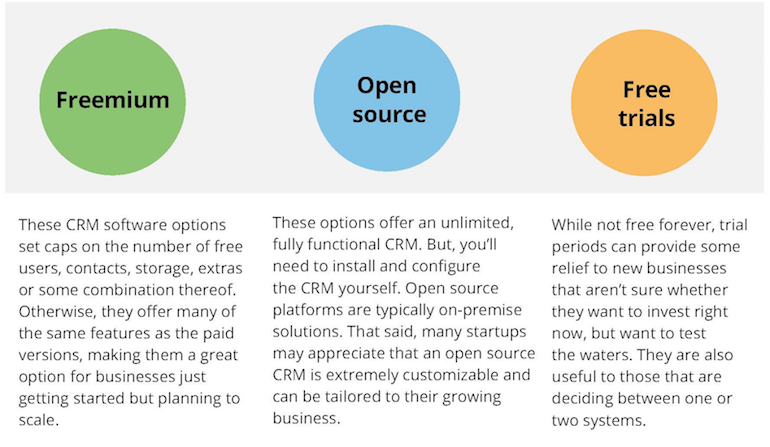
Aside from those deployment options, CRM for startups usually offers several different purchasing choices. As mentioned above, SaaS is usually priced on a per user basis. There are also various freemium, free and open source and free trial options:
A CRM purchase is one of the most important decisions a company can make—it affects many of the most important moving pieces of business in the modern world. It not only helps determine how customers perceive a particular company (i.e., the customer experience), it also determines how efficiently and effectively customer-facing employees carry out their roles.
With all this in mind, startups are encouraged to choose their CRM carefully. Take advantage of the online demonstrations vendors offer, talk to the employees who will use it and consider trying the free trials offered by the vendors on your shortlist.
Of course if you need any help starting your search, completing your shortlist or setting up demonstrations or free trials, give our advisors a call at: (844) 852-3639.