


Best Customer Experience software of 2026: which is right for you?

- Popular Comparisons
- FrontRunners
- Buyers Guide
- Related Software
Compare Products
Showing 1 - 25 of 584 products
Compare Products
Sort by
Reviews: Sorts listings by the number of user reviews we have published, greatest to least.
Average Rating: Sorts listings by overall star rating based on user reviews, highest to lowest.
Alphabetically (A-Z): Sorts listings by product name from A to Z.

Kangaroo is a cloud-based loyalty and marketing management platform designed for retail businesses of all sizes that offers memb...Read more about Kangaroo


Kangaroo's Best Rated Features
See All
Kangaroo's Worst Rated Features
See All

Startquestion is a professional survey software designed to help businesses of all sizes, freelancers, nonprofits, educational i...Read more about CustomerHero


CustomerHero's Best Rated Features
See All
CustomerHero's Worst Rated Features
See All

Preferred Patron is built for organizations that care about repeat business— from single-location shops to fast-growing multi-lo...Read more about Preferred Patron Loyalty


Preferred Patron Loyalty's Best Rated Features
See All
Preferred Patron Loyalty's Worst Rated Features
See All

livepro is a purpose-built cloud knowledge management platform for staff, customers, and partners. livepro offers the ability to...Read more about livepro

livepro's Best Rated Features
See All
livepro's Worst Rated Features
See All

NiceJob is a cloud-based reputation management solution that helps organizations manage reviews, referrals and sales. Key featur...Read more about NiceJob

NiceJob's Best Rated Features
See All
NiceJob's Worst Rated Features
See All

Broadly is a reputation management solution that helps businesses in automotive, construction, medicine and other industries str...Read more about Broadly
Broadly's Best Rated Features
See All
Broadly's Worst Rated Features
See All

Tidio is a complete customer support software suite combining a help desk, live chat, chatbot automation, and a conversational A...Read more about Tidio

Tidio's Best Rated Features
See All
Tidio's Worst Rated Features
See All

XM for Strategy & Research is a cloud-based platform designed to help organizations generate sales insights and optimize product...Read more about XM for Strategy & Research
XM for Strategy & Research's Best Rated Features
See All
XM for Strategy & Research's Worst Rated Features
See All

Yonyx is a cloud-based solution designed to help call centers and customer service businesses create and manage interactive guid...Read more about Yonyx

Yonyx's Best Rated Features
See All
Yonyx's Worst Rated Features
See All

Knowledge base software you'll enjoy using! If you're a documentation manager, customer success leader, or IT professional who...Read more about KnowledgeOwl

KnowledgeOwl's Best Rated Features
See All
KnowledgeOwl's Worst Rated Features
See All

Grade.us is a cloud-based review and reputation management solution designed for businesses of all sizes. It offers feedback col...Read more about Grade.us

TapMango is a cloud-based customer loyalty platform that assists retail stores and restaurants with rewards and promotions manag...Read more about TapMango

TapMango's Best Rated Features
See All
TapMango's Worst Rated Features
See All

Don't miss out on opportunities to grow and improve by collecting immediate feedback. Use simple one-click CSAT, CES & NPS surve...Read more about Nicereply
Nicereply's Best Rated Features
See All
Nicereply's Worst Rated Features
See All

AiTrillion is an all-in-one marketing automation platform to boost the impact of eCommerce marketing across the entire customer ...Read more about AiTrillion
AiTrillion's Best Rated Features
See All
AiTrillion's Worst Rated Features
See All

Jotform is a cloud-based form automation solution that enables users to publish online forms and record customer responses. It h...Read more about Jotform

Jotform's Best Rated Features
See All
Jotform's Worst Rated Features
See All

Sogolytics delivers speed, clarity, and scale through a powerful platform built for enterprise teams managing customer journeys ...Read more about Sogolytics
Sogolytics's Best Rated Features
See All
Sogolytics's Worst Rated Features
See All

Crewhu is a customer feedback and employee recognition software designed to help businesses improve online reputation and gamify...Read more about Crewhu

One cloud-based software to modernize and manage your dental practice. Adit makes it quick and painless to simplify all aspects ...Read more about Adit


Adit's Best Rated Features
See All
Adit's Worst Rated Features
See All

For business leaders who want to get AI right, Gladly is the only customer experience AI that delivers the cost savings you need...Read more about Gladly

Gladly's Best Rated Features
See All
Gladly's Worst Rated Features
See All

Contentsquare is for brands who offer products or services on websites or apps and are interested in offering an extraordinary e...Read more about Contentsquare

Contentsquare's Best Rated Features
See All
Contentsquare's Worst Rated Features
See All

Smile.io is a loyalty program software that gives customers from over 100,000 brands access to exclusive perks, attractive disco...Read more about Smile.io

Smile.io's Best Rated Features
See All
Smile.io's Worst Rated Features
See All

LiveAgent is a cloud-based help Ddsk solution for eCommerce businesses at the small and midsize levels. The platform offers live...Read more about LiveAgent
LiveAgent's Best Rated Features
See All
LiveAgent's Worst Rated Features
See All

Designed for businesses in insurance, travel, telecommunications, retail and other industries, Glassbox is a cloud-based solutio...Read more about Glassbox

Glassbox's Best Rated Features
See All
Glassbox's Worst Rated Features
See All

Chekkit is a cloud-based reputation management solution that caters to service-oriented businesses such as dentists, chiropracto...Read more about Chekkit

Chekkit's Best Rated Features
See All
Chekkit's Worst Rated Features
See All

Lucky Orange is a suite of conversion optimization tools designed to help businesses track and engage with visitors using heatma...Read more about Lucky Orange
Lucky Orange's Best Rated Features
See All
Lucky Orange's Worst Rated Features
See All
Popular Comparisons



Your Guide to Top Customer Experience Software, June 2025
Software Advice uses reviews from real software users to highlight the top-rated Customer Experience products in North America.
Learn how products are chosenExplore FrontRunners


“Usability” includes user ratings for Functionality and Ease of Use.
“Customer Satisfaction” includes user ratings for Customer Support, Likelihood to Recommend and Value for Money.
Reviews analysis period: The reviews analysis period spans two years and ends the 15th of the month prior to publication.
Buyers Guide
This detailed guide will help you find and buy the right customer experience software for you and your business.
Last Updated on November 17, 2025Every time your customer engages with your company in any way, they're having a customer experience. This includes every touch point and interaction across the full customer life cycle: digital encounters, product experiences, interactions with employees, and even word of mouth chatter from other customers.
Gartner defines customer experience (CX) as "the customer's perceptions and related feelings caused by the one-off and cumulative effect of interactions with a supplier's employees, systems, channels, or products." (Full article available to Gartner clients.)
The question is: how much control do you have over those experiences? And—crucially—do you understand your customers' needs and preferences well enough to cater to them?
Every customer has their own mix of expectations, needs, and tolerance levels. Customers reward businesses that deliver on their preferences and will abandon those who don't. Given these high stakes, businesses are turning to CX software to better understand their customers and how to deliver the experiences they want.
In this Buyer's Guide, we'll help you understand the following:
What is customer experience software?
Common features of customer experience software
Benefits of customer experience software
What is customer experience software?
Customer experience software is closely related to customer relationship management (CRM) software, as well as customer feedback and customer service solutions. Where CX software differs is its focus on leveraging customer insight to create actionable improvements in the customer journey. This CX transformation can happen at the individual or organizational levels.
At the individual level, CX software distinguishes individual customers from your amorphous group of “customers," defining them instead by their personal needs and preferences. In other words, it helps you define your customers as they want to be treated: as individuals.
CX software can track individual customer behavior and preferences, flag individual customers at risk of churning, leverage predictive analytics to anticipate behavior, and suggest more personalized experiences for a customer or segment of customers.
At the organizational level, CX software can track patterns at key touch points throughout the customer journey, identifying pain points or problem areas internally. This could include, for example, a comparison of customer satisfaction scores between service channels or departments. By identifying weak areas within the organization, CX professionals can work toward company procedure changes and improve the customer experience externally.
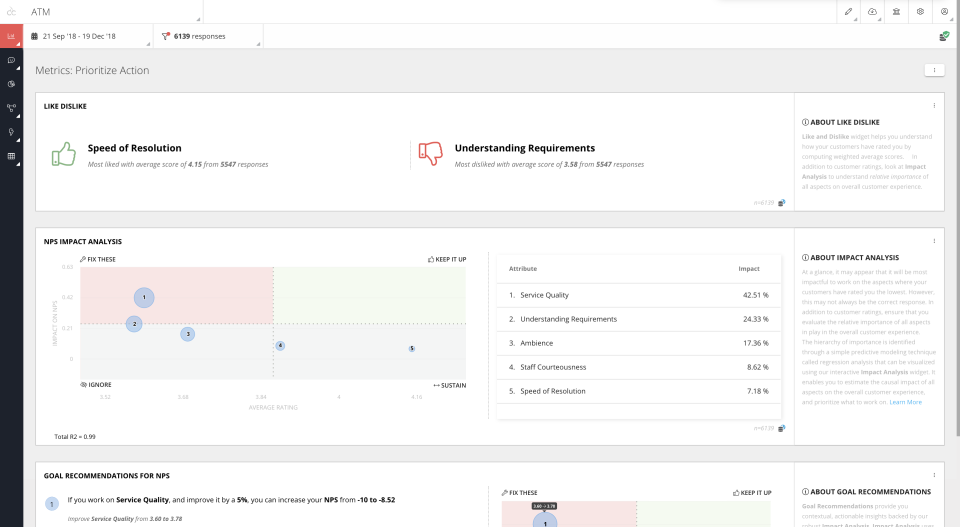
Net Promoter Score impact analysis in CloudCherry software (Source)
Common features of customer experience software
Customer experience software typically offers some or all of the following functionality:
Predictive analytics | Uses artificial intelligence, predictive modeling, or machine learning capabilities to provide deeper insights and/or suggested actions for how to improve the customer experience. |
Survey management | Allows users to design, schedule, and conduct surveys, polls, and questionnaires, as well as to collect and analyze survey data. |
Data analytics | Collects and presents data in order to analyze and report key findings on CX performance indicators. |
Text analytics | Extracts meaningful CX data from text-based interactions using natural language processing or sentiment analysis to automatically quantify and categorize text data. |
Multi-channel | A broad group of applications designed to monitor the performance of and/or communicate through various channels. This could email, live chat, social media, and more. |
Closed loop/ticketing | Tracks customer service interactions or flags customer issues and automates the issue resolution process. Creates tickets to assign agents to resolve customer issues. |
Journey mapping | Allows the user to visualize and customize customer journeys, or analyze customer satisfaction at specific touch points along the customer journey |
What type of buyer are you?
Different companies have different approaches to CX management. One of the most significant factors affecting a company's strategy is its size and organizational structure.
Enterprise businesses: Large institutions and multinational corporations are ideal candidates for the most robust and full-featured CX platforms, due in part to the complexity of their internal organizations and the scale of their customer bases. Full CX suites can monitor customer journey changes across the organization and facilitate personalized experiences for many customers simultaneously, but are fairly pricey compared to narrower software options.
Midsize corporations: Midsize businesses can usually get by with less comprehensive CX management tools, so long as they can clearly identify all business units that impact the customer experience. Many midsize companies are finding that a certain degree of cross-department cooperation is needed to support an improved CX. Management tools that monitor interactions by sales, marketing and service departments can quickly identify internal inefficiencies that lead to a poor CX.
Small businesses: Small businesses rarely need the comprehensive CX management suites used by enterprises. Instead, they often opt for channel-specific or function-specific applications. They might, for example, choose a text analytics tool to monitor their live chat and email interactions. Alternatively, they might choose a single survey tool to gather feedback from their customers on the phone, in follow-up emails or when browsing a self-service page online.
Benefits of customer experience software
While we've covered some benefits of CX software in the sections above, here are some of the most notable ones:
Better understand customers' journeys: CX software can collect and organize customer feedback at specific points throughout the customer journey, providing insight into moments that are going well and moments that need improvement.
Close the loop on customer issues: Some CX solutions offer "closed-loop" case management functionality. This means that when customers provide negative survey feedback or raise an issue, the software automates the issue resolution process, usually by creating a support ticket so staff can act quickly.
Break down silos by consolidating customer data: Most CX software is built with integrations in mind so that departments across an organization can get a deep, unified look into the customer experience. This could include operational, transactional, attitudinal, or experiential customer data.
Personalize the customer experience: Some CX solutions offer predictive analytics capabilities that facilitate individually personalized experiences, based on past customer feedback or behavior.
Explore qualitative customer feedback in-depth: Some CX software offer text analytics tools that can quickly analyze open-ended, qualitative customer comments, such as from surveys, reviews, social media, emails, or chat logs. These tools will generally code and group comments by topic, theme, or sentiment, giving you a big picture view of qualitative data.
Key considerations for purchasing customer experience software
When purchasing new software, it’s always important to take note of a few things during the buying process:
Your business’s needs: Before you decide to buy a customer experience software, you should assess your organization’s needs as well as your end goal for implementing such software. Do you want to monitor and improve the performance of your customer-facing systems? Or you want to find details on a specific area concerning customer satisfaction?
If you are looking to monitor the customer journey through your sales funnel and improve customer experiences by facilitating personalized experiences, then opt for a fully-featured CX suite with customizable surveys, customer feedback collection, and management capabilities. This will help you gain deeper insights into customers’ likes and dislikes. If you have concerns about your customers’ experience and need to dig in deeper to get more data regarding their experiences, purchase decisions, and interactions, then go for a software with narrower functionalities. This can include anomaly detection, built-in text analytics, and knowledge management.
Integration with other systems: In order to support you with information on prospective and existing customers, integration between your new software and your existing systems is important. Be sure to check with your prospective vendor to make sure that they integrate with the systems you already have in place, such as customer relationship management (CRM) software, marketing software, customer service and help desk software, and product analytics software.
Market trends to understand
As CX software fragments, know what you're looking for. The CX software market overlaps heavily with related software such as CRM, customer service, customer feedback, and customer engagement—this results in a fragmented landscape. According to Gartner, as the benefits of a customer-centric approach become more well known, some vendors from related software markets are branding their products as CX solutions, which may not have full-featured CX functionality (full content available to Gartner clients).
Businesses looking for a full-featured solution will be pleased with all that a CX suite has to offer. At the same time, CX is broad, as it encompasses any and all types of customer experiences. In this way, businesses that want to focus on a particular type of customer experience or that need a specific, narrow feature set should look at CX software as well the closest related market.